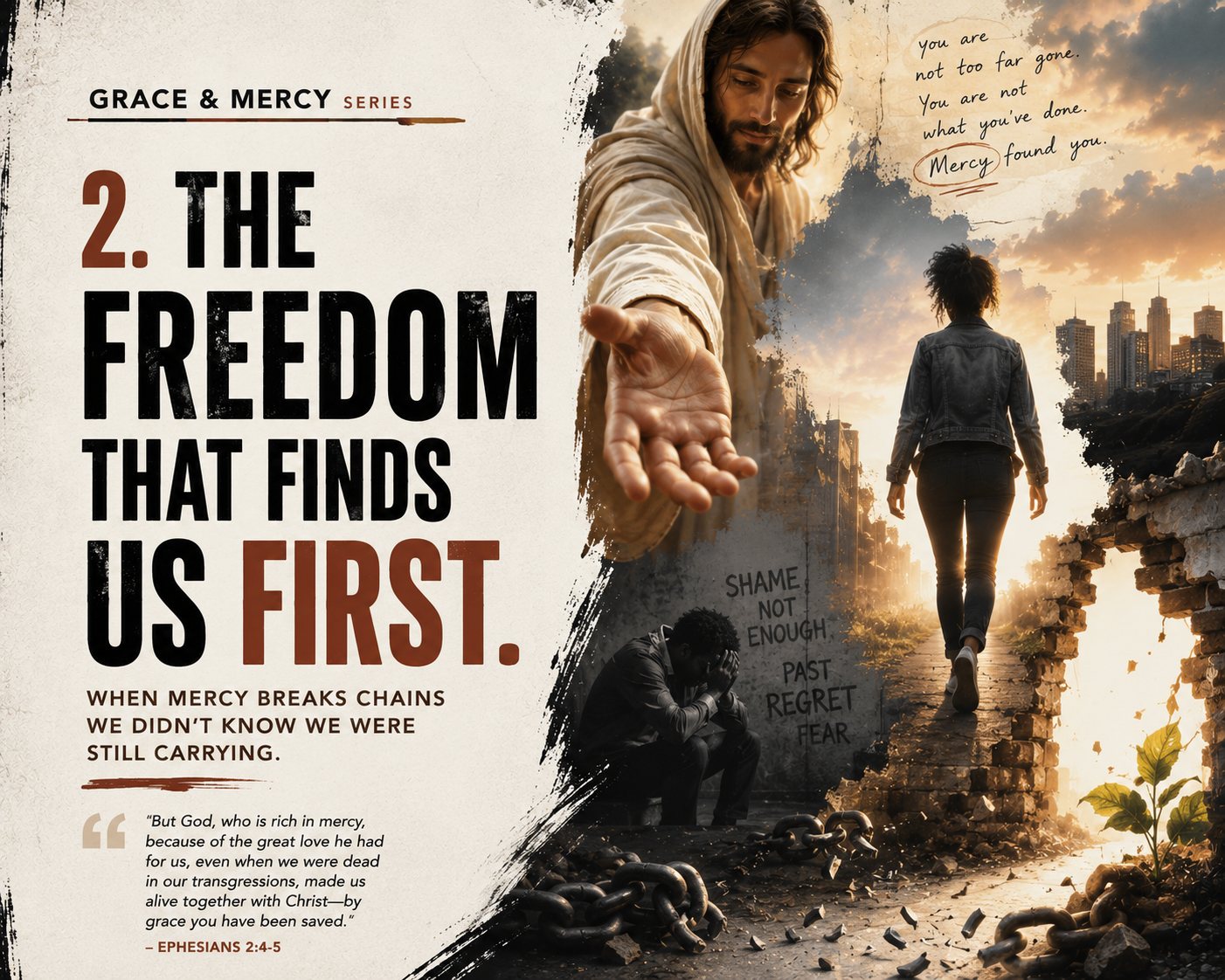
Most of us aren’t carrying one chain.
We’re carrying a whole set. Shame. Not enough. The past. Regret. Fear. We’ve worn them so long we stopped feeling the weight. They don’t feel like chains anymore. They feel like personality.
“That’s just how I am.”
“I’ve always been the one who messes things up.”
“People like me don’t get second chances.”
We say it like a fact. It’s a sentence. And somebody handed it down.
Here’s the order Scripture puts things in.
“But God, being rich in mercy, because of the great love with which he loved us, even when we were dead in our trespasses, made us alive together with Christ — by grace you have been saved.” — Ephesians 2:4-5
Read it slowly. Even when we were dead.
Not after we cleaned up. Not once we got our story straight. Not when we finally had something to show for ourselves.
Dead people don’t do anything. They don’t apply. They don’t qualify. They don’t finish the program.
Mercy moved first.
That’s the whole Gospel in two words: But God. Everything before that phrase is what we did. Everything after it is what He did anyway.
We keep reversing the order.
The church says grace is free, then hands people a checklist at the door. Get sober first. Get married first. Get your record cleared, your story cleaned up, your clothes right. Then you can sit up front.
We preach the prodigal son and act like the older brother.
Remember how that story actually goes. The son is still on the road, still rehearsing his speech, still planning to ask for a job instead of a family. And the father sees him “while he was still a long way off” and runs.
The father doesn’t wait for the apology. He interrupts it.
That’s what freedom looks like when it finds you first. It doesn’t wait at the house with its arms crossed. It runs down the road and meets you in the condition you’re in.
The chains we didn’t know we had.
Here’s the hard part. Sometimes the chains aren’t the sin. Sometimes the chains are what we built around it.
The shame that tells you to stay in the back row. The fear that keeps you from telling anybody the truth. The regret you’ve replayed so many times you know it better than Scripture. The voice that says not enough every time you try something new.
Jesus already broke those. Most of us just never stood up and walked out.
Some of us were told we couldn’t. By a pastor. By a parent. By a church that loved us right up until it found out.
So let me say it the way the graphic says it:
You are not too far gone. You are not what you’ve done. Mercy found you.
Now the part we don’t like to talk about.
If God doesn’t keep a record of our wrongs, why do we?
We’ve built a whole society that does the opposite of Ephesians 2. A man serves his time and walks out with a record that follows him to every job application and every lease for the rest of his life. A woman gets clean and can’t get custody back because a file from six years ago says who she used to be. We call it accountability. A lot of the time it’s a chain we bolted on after the sentence was already served.
And the church, the people who claim to have been set free, is often the last place pushing back.
If we really believe mercy moves first, it should show up in what we do:
- Back expungement and record-sealing efforts in your state, and help people actually file. The paperwork is where most second chances die.
- Hire people with records. Rent to them. Put your name on the reference line.
- Make your church a place people can tell the truth about where they are right now. Not where they were. Not where they hope to be. Where they are.
- Stop asking people to earn a seat. Give them the seat, then walk with them.
- Look at who you’re still holding something against. Ask whether God already let it go.
Freedom isn’t the prize at the end.
It’s the starting line.
We don’t get free by trying harder. We get free because somebody came looking for us before we ever thought to look for Him. The work we do after that isn’t us paying it back. It’s us finally walking around without the weight.
Stand up.
The door’s already open.
This is the second post in Grace & Mercy. Part one asked why the church stopped reaching. This one is about what reaches us first. Next: what happens when we start worshiping certainty instead of humility.